
Three readers of my new science thriller Biohack contacted me today about NPR's report titled, "Her Son Is One of the Few Children to Have 3 Parents." The well-reported eight-minute dispatch from Rob Stein tells the story of a 31-year-old woman in western Ukraine who went through years of IVF treatments without success.
"The doctors would fertilize one of her eggs with her husband's sperm," Stein says in the story. "Then, use her husband's sperm to fertilize an egg from another woman paid to donate her eggs. Next, remove most of the DNA from the other woman's fertilized egg and replace it with Tamara's and her husband's genes."
Why go through this three-part process? "The idea is that a tiny bit of DNA left over from the other woman might make the difference. It provides energy for the egg and embryo." I take this to mean they borrowed the donor's mitochondrial DNA.
"The resulting baby would have DNA from three different people," Stein's report went on. And it worked. Tamara was able to get pregnant, and her son is now 15 months old.
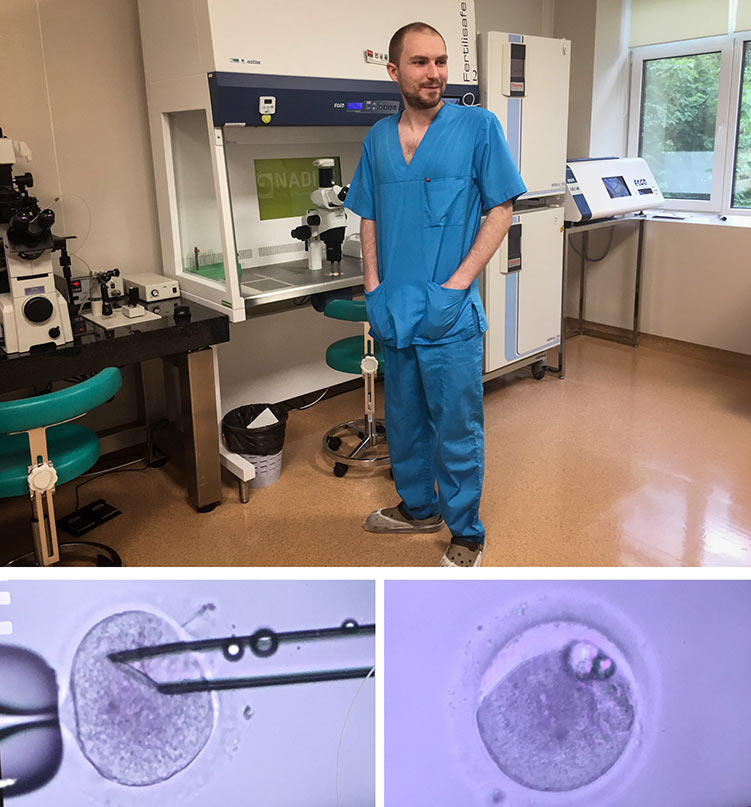
The procedure is banned in the United States, so one U.S. doctor went to Mexico to make a baby this way. Britain is now allowing it in rare cases for women with mitochondrial disorders.
The new mother, Tamara, paid about $8,000 for the procedure, and it charges women who come there from abroad about $15,000. The clinic says it's created four healthy babies this way, and three more women are pregnant.
An accompanying piece on NPR.org went on to say:
"This is pretty troubling," says Marcy Darnovsky, who heads the Center for Genetics and Society, a U.S.-based watchdog group. ...
"What we're seeing is a fast slide down a very slippery slope toward designer babies," Darnovsky says. "We could see parents feeling eager to give their children traits like greater strength, needs less sleep. Some people are saying that, 'Yes, there are genes for IQ and we could have smarter babies.' "
But is it? To my mind, it's an advance that allows women who can't bear their own children to have their own biological children. That's a far cry from designer babies. And some observers also take a more benign view.
"What we can learn from their work is that pronuclear transfer may be useful for some cases of infertility," says Egli.
I agree.
What's your view?

For me, the biggest wild card is whether it turns out to be a health risk to the child. If there’s science that says it will or is likely to be, all such births are experiments on human subjects without their knowledge or consent. As far as the rest of the factors sure to creep people out in this scenario, it would be interesting to know how many fertilized embryos the world has in cold storage (5-7 figures worth at least, I’m guessing), and what percentage of them are actively slated for destruction if not implanted (which is sometimes done to eliminate the risk of loss/theft/ultimate unauthorized implantation and birth of the embryo). If we’re ok with destroying them, I don’t see much ethical/philosophical difference in replacing most of their DNA — but there’s an if there.